The name “paper nautilus” can be misleading. Argonauts are pelagic octopuses, while a chambered nautilus is a different cephalopod with a hard, divided shell. The original Cannon Rocks Village article discusses argonauts, chambered nautiluses and Spirula, and records local beach finds. Its complete recovered text is reproduced below as part of this featured story.
The paper nautilus is an argonaut
An argonaut belongs to the octopus group. The female makes a delicate, paper-thin egg case using modified arms; it holds the eggs and can also help with buoyancy. It looks like a nautilus shell, but it is not the chambered shell in which a true nautilus lives. The Smithsonian Ocean explains the distinction and describes how the chambered nautilus uses gas and fluid in its shell chambers to regulate buoyancy.
The two structures are easy to confuse when only a washed-up case or shell is visible. A useful first question is therefore not “Which nautilus is this?” but “Is this an argonaut egg case, a true nautilus shell, or another cephalopod structure?” Shape alone may not settle the identification.
How a chambered nautilus shell differs
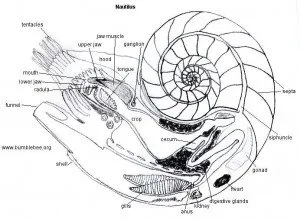
A chambered nautilus lives inside its hard external shell. Internal walls divide the shell into chambers, and a tissue tube called the siphuncle runs through them. The living animal occupies the largest chamber; the others form part of its buoyancy system. Smithsonian Ocean describes this chambered structure separately from the thin egg case of an argonaut.
Argonaut and nautilus cases are a striking example of similar-looking structures serving different roles. One is an egg case made by an octopus; the other is the external shell of a different animal.
What the original Cannon Rocks article records
The original village article, “Nautilus Shells and the Creatures Living in Them – Argonauts,” discusses argonauts, chambered nautiluses and Spirula, and reports Spirula shells found at Cannon Rocks. The captured source shows no author byline or publication date. Its complete recovered text appears in the original source article below.
That original article cites Julian K. Finn’s 2013 research on argonaut taxonomy and biology. The paper is useful background for understanding the group; it is not a recent, site-specific survey of Cannon Rocks. A shell found on a beach can be recorded as a beach find, but the find alone does not establish where the living animal was, or which species produced it.
Reading a beach find carefully
The distinction between an observation and an identification matters. A dated photograph, measurements and a clear record of where a specimen was found can support later review. A confident species name or local population claim needs stronger evidence than resemblance to a familiar shell shape.
This featured story adds sourced context while preserving the complete original article and its images below. The source article has no recorded personal byline, so no individual author is assigned to it.
Sources
- Smithsonian Ocean: “Cephalopods: Octopus, Squid, Cuttlefish, and Nautilus” — argonaut egg cases, nautilus shell chambers and siphuncle.
- Julian K. Finn (2013), “Taxonomy and biology of the argonauts”, Molluscan Research, 33(3), 143–222.
- Cannon Rocks Village: original Nautilus Shells article — preserved source text and its original claims.
Sources checked 19 October 2026.
Original source article
Nautilus Shells and the Creatures Living in Them – Argonauts
Original byline: No author byline was shown on the captured source page.
Original publication date: Not shown on the captured source page.
ARGONAUTS
As we are into “paper nautilus season” I thought a few words on these delicate and much sought after brood shells might be of interest to residents and visitors.
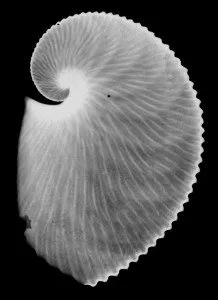
What we all call paper nautiluses are a group of pelagic octopuses more correctly called Argonauts. The female Argonauts secrete their paper-thin calcite shells as brood chambers into which they lay their eggs and in which they develop. This structure is not a true cephalopod shell, unlike that of the Chambered, or Pearly Nautilus, but rather an evolutionary innovation unique to the genus Argonauta and is used purely as a brood chamber – it is not the analogue of a mollusc shell. It was once speculated that the argonauts did not manufacture their own eggcases but instead borrowed them from other organisms, in the manner of hermit crabs and that Argonauta used their shell-secreting arms as sails when they were at the surface. Trapped air in the brood shell enables the animal to control her buoyancy and hence her depth range. Male Argonauts do not make a shell and are considerably smaller than the females.
Historically, taxonomic determination of the group has relied on features of their brood shells – structures which are not homologous to true molluscan shells and prone to extreme variability. As a consequence of this, more than 50 species names have been coined worldwide to date. That all changed when an Australian researcher, Dr Julian Finn, completed what is the most comprehensive, in depth study of the Family. His findings are recorded in the Journal ‘Molluscan Research’ published in 2013[1]
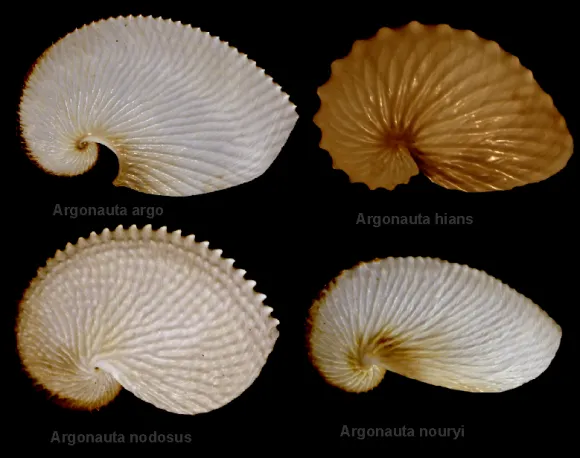
Finn’s research show that there are actually only four species, three of which occur in our area (the fourth, Argonauta nouryi, occurs on the Pacific coast of North America from Panama to Baja California).
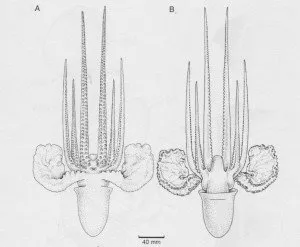
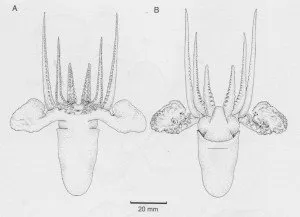
Our species are Argonauta argo, A. nodosus and A. hians. Our most common species is A. argo which can attain a maximum length of some 300mm. Also of similar size is A. nodosus which, though the more common species in Australia, is deemed rare in South Africa[2]. Once thought to be A. boettgeri, our little brown ‘nautilus’, A. hians, is not as uncommon as once thought. Perhaps its small size (up to 75mm) and sandy colour makes it less obvious on the beach.
Julian K. Finn (2013), Taxonomy and biology of the Argonauts (Cephalopoda: Argonautidae) with particular reference to Australian material. Molluscan Research, 33:3, 143-222
When a scientist describes a new species he has to select an example which is typical of the species. This is called the Type specimen and is the ultimate reference for that species. The locality where this Type specimen was found is called the Type Locality. Strange though it may seem, the type locality of A. nodosus is the Cape yet the species is by no means common here!
NAUTILUS
A very different creature is the proper Chambered or Pearly Nautilus of which there are six living species in two Genera.
The best known species in Nautilus pompilius which is circumtropical in its distribution inhabiting deep slopes of coral reefs. Nautiluses usually inhabit depths of several hundred metres. Gas exchange within the shell is a slow process and its implosion depth is thought to be around 800 m
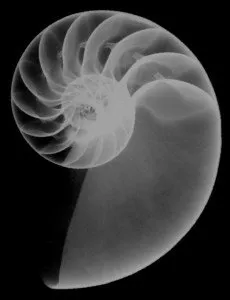
Nautilidae, both extant and extinct, are characterized by involute shells that are generally smooth, and have a tubular, generally central siphuncle by which the animal adjusts its buoyancy. The shells are not brood chambers, as in the Argonauts, but a true analogue of mollusc shells composed of aragonite. Having survived relatively unchanged for millions of years, nautiluses represent the only living members of the subclass nautiloidea and are often considered “living fossils”.
X-rays of Argonaut brood shell (left) and Nautilus shell (right) in which the chambers and siphuncle can be clearly seen.
And what sort of creatures are they that take such care of their young and make these beautiful creations? In the case of our Argonauts they are a type of octopus; that is they are soft-bodied molluscs that have eight arms, a parrot-like beak, mantle, ink gland, and a siphon with which they propel themselves. Two of their arms are developed into paddle-like blades; these they use to secrete the brood case shell – they do not live within this ‘shell’ but cling tightly onto it using their modified arms. They feed on small crustaceans, molluscs and jellyfish.
Nautilids differ markedly from all other cephalopod molluscs. Whereas most other cephalopods have eight arms (octopus) or eight arms and two tentacles (decapods such as squids and cuttlefish), the Nautilus may have up to 90 short arms! They live wholly within their shell, just as a gastropod mollusc does, and lay eggs which are attached to rocks or other stable parts of the reefs where they live. They are scavengers and opportunistic predators.
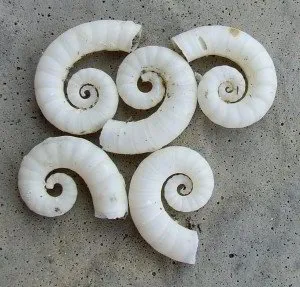
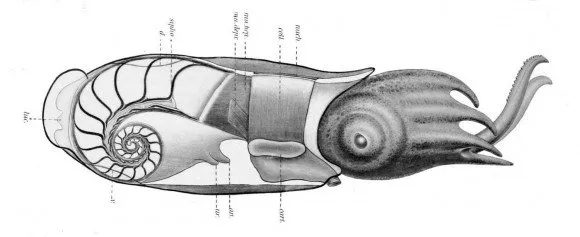
We cannot leave these fascinating marine creatures without mentioning one other whose tiny coiled shells we often find washed ashore. These are Spirula, tiny deep sea squid-like decapods (eight arms and two tentacles), about 35mm to 45mm long. Their small, white, coiled internal buoyancy compensating shells are commonly known as spirula or rams-horn shells.
Female Argonauta argo (left) and Argonauta hians (right). From Julian Finn (a = dorsal, b = ventral).
Spirula spirula ‘shells’ from Cannon Rocks and S. spirula (By Ewald Rübsamen – Die Cephalopoden)
Images from the original Nautilus article
The image gallery below preserves the figures from the original article. Original captions and credits are carried over where the source page recorded them.
Images from the original Nautilus article